The data stack made business state queryable. Execution never has.
2026-05-19
The data stack evolved from storage → analytics → AI reasoning.
The next step is execution.
And we're building it in the wrong place.
What if every action an AI agent took was a row in your warehouse?
Not a log. Not an audit trail. A first-class data object — queryable, joinable, permanent — alongside the operational data that justified it.
Sridhar Ramaswamy described the Agentic Enterprise as four components — data, AI models, applications, and a control plane that coordinates them. The hardest piece is the part that decides — whether a specific action should fire right now, given the live state of the business. That decision has to read warehouse data at the moment it's made. That's the part I built.
An action is only trustworthy if it was evaluated against the data that makes it consequential.
Should this ad budget increase execute? Depends on what the ROAS is right now, in your warehouse. Should this customer credit be auto-approved? Depends on whether their dispute history crosses a threshold.
That data exists. It's sitting in Snowflake. But when an agent acts today, that context is invisible at the moment of execution. The action fires. The data that should have shaped it was never consulted.
This is why agents cause incidents.
Not because they're unintelligent. Because the operational data that makes their actions consequential isn't in the execution path.
The data stack made business state queryable. Execution never has. When an agent triggers a workflow, the action disappears into external systems — no policy context, no record of what state existed when it fired.
In Tessra, an action is a first-class data object — the intent, the live data the policy read, the verdict, who approved it (if anyone), the receipt of what happened.
When an agent proposes an ad budget increase, Tessra reads live campaign metrics from Snowflake and evaluates at the moment it's requested:
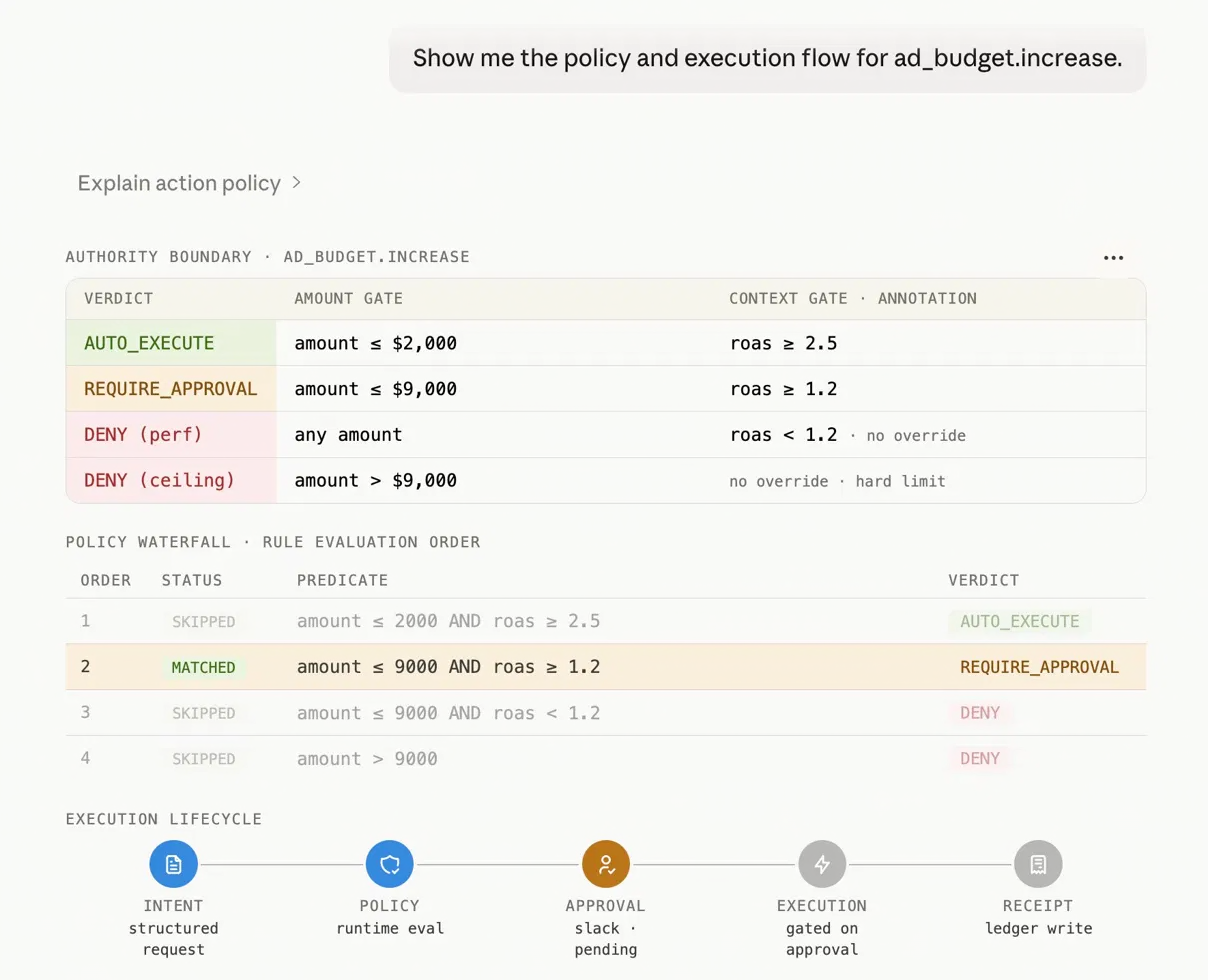
- AUTO_EXECUTE — amount ≤ $2,000, ROAS ≥ 2.5
- REQUIRE_APPROVAL — amount ≤ $9,000, ROAS ≥ 1.2
- DENY (performance) — ROAS < 1.2, no override
- DENY (ceiling) — amount > $9,000, hard limit
The decision, with its full context snapshot, becomes a row in your warehouse. You query execution history the same way you query business data.
Whatever your warehouse already enforces comes along. RBAC, masking, residency, your SOC 2 controls — all of it applies to receipts the same way it applies to the data they read. You inherit the trust you already built.
Snowflake is the data layer. Project SnowWork is their new AI platform for non-technical users. Tessra is the policy-evaluation primitive — what decides whether a governed action fires, grounded in the data that makes it consequential.
Not a governance wrapper. The primitive that brings execution inside the data plane.
We're opening early access ahead of Snowflake Summit (June 2–5). One real action, end to end, in your account.
→ tessra.ai, or reach out directly.
Sridhar's post: The Agentic Enterprise