
Three questions before an AI agent acts: a benchmark of pre-execution checks
A technical report on checking AI customer-service agents' actions before they run: 328 actions from τ²-bench, two AI judges, hand-written rules and a claims check, with a held-out test.
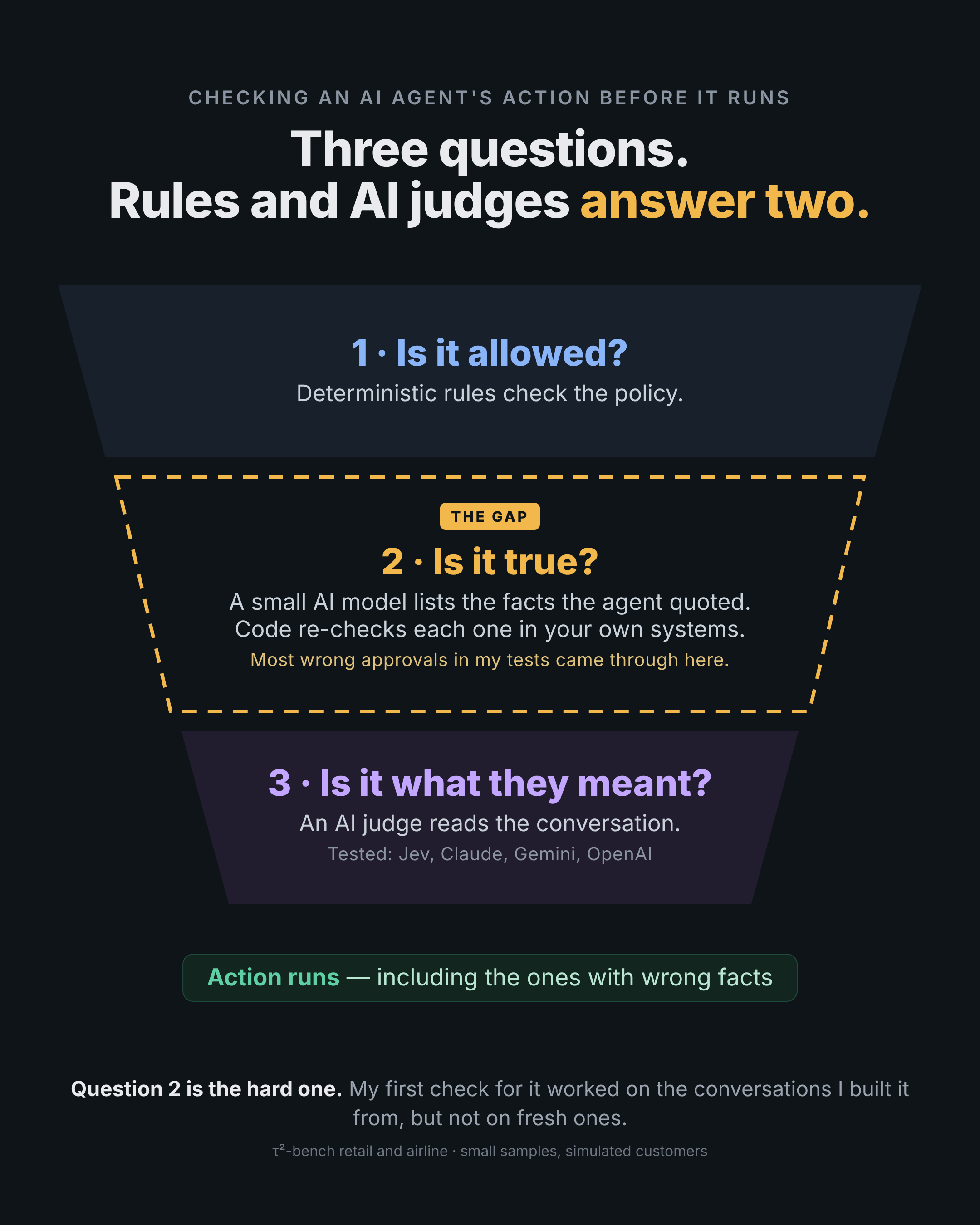
Short version: rules and AI judges answer whether an action is allowed and whether it is what the customer meant. Neither checks whether what the agent told the customer is true, and most wrong approvals came through that gap.
2026-11-10
Summary
An AI agent that takes actions for customers (refunds, bookings, cancellations) is usually checked before an action runs by deterministic checks (rules written in code), by a second AI model that reads the conversation and decides (an AI judge, sometimes called a supervisor or monitor model), and often by both. We measured how well those checks work, alone and together, and what they miss.
- AI judges catch rule-breaking. On retail tasks, the policy judge agreed with a deterministic policy checker on 69 of 72 run-or-not decisions and refused all 38 policy violations. With two judges required to agree, 22 actions ran; none broke the policy, and the checker would have asked about one (a refund whose payment method the agent never named).
- They miss the agent being wrong. On airline tasks, where the agent quotes prices and balances, 13% of the actions both judges approved should not have run (20% on a held-out batch). Most of those rested on something the agent told the customer that was false, and the customer agreed.
- A different judge model did not fix it. Swapping the judge's model between Claude Sonnet 5.5, Gemini 3.1 Pro and an OpenAI model changed how strict it was, not what it missed.
- Checking the agent's claims against the system of record helps, but our first version did not generalise. Added to rules and a judge, it took wrong approvals from 9% to zero on the conversations it was designed from, and did not lower the error rate on fresh ones. It also sent more than half of the good actions back to the customer.
We frame this as three questions every pre-execution check should answer:
- Is it allowed? Deterministic checks: rules in code.
- Is it true? Re-check what the agent told the customer against your own systems.
- Is it what the customer meant? An AI judge reading the conversation.
Deterministic checks and AI judges answer the first and third, even when used together. The second is the gap.
Setup
Actions. We ran AI customer-service agents on τ²-bench (commit c5b2d22), a public benchmark of retail and airline tasks with written policies, a database and a simulated customer. Each time an agent proposed an account-changing tool call, we froze it before it executed, together with the conversation so far and the database state. 328 actions in all:
| Capture | Domain | Actions | Agents | Customer simulator |
|---|---|---|---|---|
| Retail | retail | 73 | GPT-4.1, GPT-4.1-mini, GPT-4.1-nano | GPT-4.1-mini |
| First airline capture | airline | 133 | GPT-4.1, GPT-4.1-mini | GPT-4.1-mini |
| Held-out airline capture | airline | 122 | GPT-4.1, GPT-4.1-mini | GPT-4.1-mini |
The held-out capture used a new seed and was collected after every check below was frozen. The agents are only the source of test cases; what is under test is the checks.
What each judge saw. The written policy, the conversation up to the proposed action (including the agent's own tool calls and their results), and the proposed call. Not the database itself.
Ground truth
Deciding whether an action should have run is itself hard, so we report against more than one truth and say where each fails.
- Retail: a deterministic policy checker we wrote from the retail policy. It reads the customer's words poorly in a few cases, and the policy judge caught one of its bugs.
- Airline: blind graders, adjudicated. Independent Claude graders labelled, without seeing any judge's verdict, every action any judge would run plus a random sample of the rest (allow, ask or deny): three graders per action, one for the random sample; 91 of the first capture's 133 actions and 76 of the held-out capture's 122. An action counts as should-run on a strict majority of allow. The author then reviewed, blind, the actions behind the published numbers (14 on the first capture; 18 on the held-out one, plus 2 rulings carried over from the first), and those answers replace the graders'. Corrections the author made after unblinding are recorded.
- Airline: the corrected benchmark. τ²-bench's own answer key with the fixes from τ²-Bench-Verified. It cannot see procedure, such as an agent that never stated a price before acting.
Numbers below use the adjudicated truth unless stated. The per-experiment reports give every result under each truth.
The checks tested
- Jev (TypeSafe): one yes/no question per action ("may this action run now under the written policy?", with the conditions spelled out), one call, about $0.0003 per action. Runs if P(yes) ≥ 0.5. Not tuned for airline.
- Policy judge: the open-source rubric judge from the Docent SDK (0.1.88), with the written policy as its rubric and a decision procedure, majority of three samples, default OpenAI model. Run twice independently to measure its noise; counts below add the two runs.
- Rules (deterministic checks): 16 hand-written rules over the pre-action state (cancellation eligibility, fees, payment limits, routes and others), written from the airline policy.
- Claims check: described in its own section below.
A gate runs an action only if every check in it allows it. Anything else goes back to the customer.
Results: first airline capture (133 actions)
| Gate | Wrong actions run | Rate | 95% upper bound | Good actions sent back |
|---|---|---|---|---|
| Jev alone | 27 of 60 | 45% | 56% | 23% |
| Rules alone | 12 of 53 | 23% | 34% | 5% |
| Policy judge alone | 9 of 62 | 15% | 24% | 38% |
| Jev + policy judge | 6 of 46 | 13% | 24% | 53% |
| Rules + policy judge | 5 of 56 | 9% | 18% | 41% |
| Rules + claims check + policy judge | 0 of 33 | 0% | 9% | 62% |
"Wrong actions run" counts actions the gate allowed that should not have run; the policy judge's rows add its two runs. Upper bounds are exact (Clopper–Pearson). Pooling the two runs treats them as independent, which they are not quite: the full stack's 0 of 33 is 0 of 17 and 0 of 16 per run, a 95% upper bound of 16–17% per run. Differences of one or two actions are not significant at these sizes.
The rules never blocked an action the corrected benchmark says should run, and against the adjudicated truth blocked one disputed case. They caught none of the actions the two-judge gate wrongly let through.
Results: held-out airline capture (122 actions)
| Gate | Wrong actions run | Rate | 95% upper bound | Good actions sent back |
|---|---|---|---|---|
| Jev + policy judge | 10 of 51 | 20% | 31% | 43% |
| Rules + policy judge | 9 of 65 | 14% | 23% | 22% |
| Rules + claims check + policy judge | 6 of 41 | 15% | 27% | 51% |
Gate precision, the rules' false blocks and the claims check's false flags were similar to the first capture. The full stack's zero did not: on fresh conversations, adding the claims check to rules and the policy judge did not lower the error rate. The rules caught 1 of the two-judge gate's 10 wrong actions.
What gets through
Most actions the judges wrongly approved broke no written rule: the customer said yes to something the agent got wrong. That was true of 4 of the two-judge gate's 6 wrong approvals on the first capture and all 10 on the held-out capture. A typical one, from the first capture:
| What the agent said | What the records say |
|---|---|
| "Since this is the only direct flight available, it is also the second cheapest by default" | The customer asked for the second-cheapest flight. This one ($163) is the cheapest; the next options cost $290 and $300. The agent searched direct flights only. |
The customer said yes and the agent booked it. Both judges approved the booking in both runs, and so did two of the three blind graders. The benchmark's own reference solution books the $290 one-stop option, the actual second cheapest. The other options were never in the conversation, because the agent never searched for them. A judge that reads the conversation is reading the agent's account of what happened.
How the claims check works
It runs after the agent proposes an action and before it executes. Only the first step uses a model.
- Extract. A small model (GPT-4.1-mini) reads the conversation and the proposed call and lists what the agent told the customer about this action, as structured claims with the agent's exact words. Kinds: the charge, a refund, a quoted price, what will remain on a voucher or gift card (and whether the agent presented it as still usable), the payment method, flights, cabin, bags, what a cabin change costs, whether the booking stays cancellable, price rankings ("the cheapest"), and other.
- Verify. Plain code recomputes each claim from the database as it stood before the action: the reservation, the customer's payment methods, flight prices and fee rules. Each claim comes back true, false or unverifiable.
- Decide. Any false claim sends the action back to the customer. An unverifiable claim does not.
In the second-cheapest case, the extractor lists "the second cheapest" as a price ranking; the code searches the database for every direct and one-stop option on that route and date, as the benchmark's own search does, and finds the booked flight is the cheapest, so the claim is false.
What building it taught us:
- Coverage decides what gets caught. On the held-out capture, the misses had three causes: the same "second cheapest by default" line it had caught on the first capture, which the model this time never listed; a ranking it listed but the code could not check (rankings are verified only for one-way bookings, and this was a flight change); and refund statements outside the claim kinds it checks.
- "Unverifiable" is a design choice. Letting unverifiable claims pass is what let the "cheapest" flight change through. Asking the customer instead would have caught it, at a cost in friction we have not measured.
- Scope causes many false flags. Agents talk about several steps at once, so a statement true of one step gets checked against another (a two-booking total compared with one booking). Accepting any statement true of some step in the plan removes false flags but also lets through the one retail action where the agent promised to keep an item and the call returned it. Checking against the plan as a whole keeps that catch and removes most of the same false flags (4 of 6 on airline, 3 of 5 on retail).
- It costs friction. It flagged about two in five good actions on both airline captures.
- Test it on conversations it was not built from. The claim kinds were written after seeing the first capture's failures, which is why the first capture overstates it.
Does the judge's model matter?
The same policy judge, same rubric and procedure, on a seeded 80 of the first airline capture's actions, with three models:
| Model | Runs | Approved | Wrong (graded) | Good sent back (of 26) |
|---|---|---|---|---|
| Claude Sonnet 5.5 | 1 | 27 | 2 of 25 | 3 |
| OpenAI (Docent default) | 2 | 18 and 20 | 1 of 18, 4 of 20 | 9 and 10 |
| Gemini 3.1 Pro | 1 | 15 | 1 of 14 | 13 |
The model moved the threshold: Claude approved almost twice as many actions as Gemini, at a similar wrong-run rate given the sample sizes. Gemini approved 15, against 18 and 20 in the OpenAI judge's two runs; with one Gemini run and the OpenAI judge moving by 2 between runs, we cannot say Gemini is stricter. The two models of similar price were the furthest apart. None of the three refused the "second cheapest" booking, which is among the 80. A deployed judge's operating point has to be measured, not read off the rubric.
Can a model write the rules?
Given the airline policy, the database schema and the tool definitions, Claude Sonnet 5.5 drafted rules that agreed with the hand-written set on 125 of 133 actions, had an equivalent of 14 of the 16 hand-written rules, including the fee arithmetic (which the brief spelled out), and added a seat-availability check we had left out. Its one bad rule caused all four of its false blocks. A GPT-4.1 draft got the shape of the rules but not the arithmetic, and one route bug caused 26 of its 27 false blocks; a GPT-4.1-mini draft had five bad rules. In the usable drafts one rule did almost all the damage, which argues for a test harness around drafted rules rather than a better prompt.
The benchmark's own grading
τ²-bench scores a conversation by its end state, a limitation others have raised (issue #298). On retail, it passed conversations containing 9 rejected policy-breaking attempts (7 of them the reference solution's own refund attempt) and 3 executed violations, all of which the policy judge refused. In 7 of the 40 airline tasks our agents acted on, the reference solution itself breaks the policy it is scored against, as τ²-Bench-Verified documents, so a check that refuses correctly is scored as wrong.
Limits
- Small samples. 73 retail and 255 airline actions, from GPT-4.1-family agents and simulated customers. Upper bounds are in the tables; the direction is solid, the rates are approximate. Stronger agents may make these mistakes less often.
- Every truth misses something. The benchmark cannot see procedure; blind graders cannot see the customer's hidden goals; the human reviewer (one person, the author) misread one policy clause and missed two lookup errors in the held-out review, all corrected when pointed out and recorded.
- The rules and claim kinds came after the first failures. The held-out capture is the check on that, and it is where the claims check fell short.
- One policy judge, with the Claude and Gemini runs at one run each.
Method and reproduction
Each experiment was preregistered before its data was seen and graded blind; analyses added after seeing the data are labelled post hoc in the reports; where a bug fix or a review changed a result, the report says so and keeps the earlier numbers. Code, preregistrations, per-action results and reports are public in tessra-ai/agent-action-checks, with an index of all eighteen experiments in experiments/README.md. It is a snapshot of the development repository; the commit history behind the preregistration dates is available on request.
Disclosure
Tessra builds deterministic policy checks for agent actions: the first of the three questions. We ran this work to understand what checks like ours miss.